Several million stars are vying for attention in this NASA/ESA Hubble Space Telescope image of a raucous stellar breeding ground in 30 Doradus, located in the heart of the Tarantula nebula. Continue reading

Several million stars are vying for attention in this NASA/ESA Hubble Space Telescope image of a raucous stellar breeding ground in 30 Doradus, located in the heart of the Tarantula nebula. Continue reading

Observations by the NASA/ESA Hubble Space Telescope have come up with a new class of planet, a waterworld enshrouded by a thick, steamy atmosphere. It’s smaller than Uranus but larger than Earth. Continue reading

Astronomers using data from NASA’s Kepler mission have discovered the three smallest planets yet detected orbiting a star beyond our sun. The planets orbit a single star, called KOI-961, and are 0.78, 0.73 and 0.57 times the radius of Earth. The smallest is about the size of Mars. Continue reading

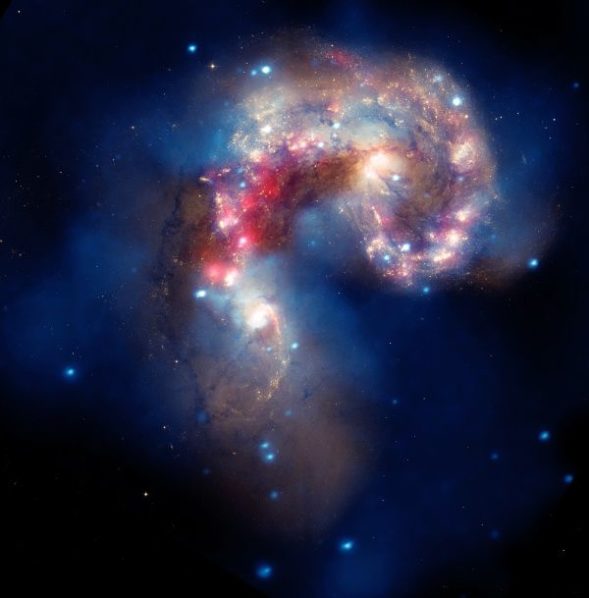
This beautiful image of two colliding galaxies has been released by NASA’s great observatories. The Antennae galaxies are located about 62 million light-years from Earth. They take their name from the long antenna-like “arms,” which were produced by tidal forces … Continue reading

Astronomers on Tuesday (Dec. 20) announced the discovery of the first two Earth-size alien planets – a historic find for sure, but the newfound worlds didn’t exactly receive historic names. The two alien planets are officially known as Kepler-20e and Kepler-20f, a nod to the instrument that detected them, NASA’s prolific Kepler space telescope. Continue reading

After spending more than 240 days “sailing” around Earth, NASA’s NanoSail-D — a nanosatellite that deployed NASA’s first-ever solar sail in low-Earth orbit — has successfully completed its Earth orbiting mission. Continue reading

The youngest planet yet discovered has been found orbiting within the disk of dust and gas surrounding the star Lk Ca 15. The planet is more than just young: it may still be in the process of formation. Continue reading

NASA’s Spitzer Space Telescope has detected signs of icy bodies raining down in an alien solar system. The downpour resembles our own solar system several billion years ago during a period known as the “Late Heavy Bombardment,” which may have brought water and other life-forming ingredients to Earth. Continue reading

The International Space Station may have to start operating without a crew in November if Russian engineers don’t figure out soon what caused a recent rocket failure, NASA officials announced today. The unmanned Russian cargo ship Progress 44 crashed just after its Aug. 24 launch to deliver 2.9 tons of supplies to the orbiting lab. Continue reading

Honeycomb Carbon Crystals Possibly Detected in Space. NASA’s Spitzer Space Telescope has spotted the signature of flat carbon flakes, called graphene, in space. If confirmed, this would be the first-ever cosmic detection of the material – which is arranged like chicken wire in flat sheets that are one atom thick. Continue reading