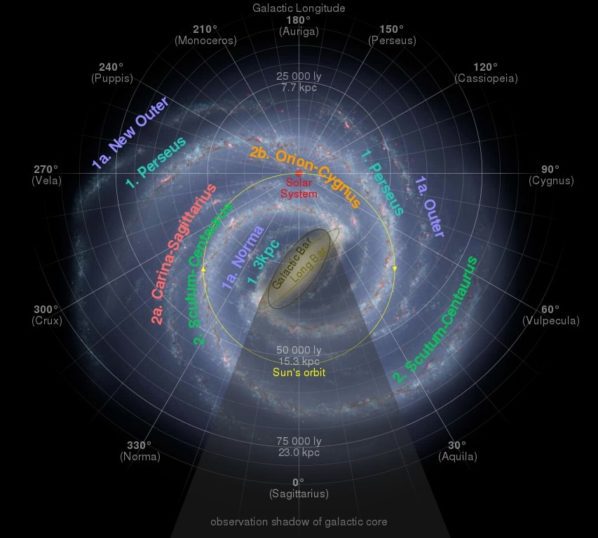
Carina-Sagittarius Arm of the Milky Way Galaxy
Explore the mysteries of the Carina-Sagittarius Arm in the Milky Way, a minor spiral arm revealing unique celestial features and offering insights into the galaxy's dynamic structure.
Galactic Archaeology: Unveiling the Secrets of the Universe
Galactic archaeology, a branch of astronomy, studies the Milky Way's history, evolution, and origins by scrutinizing stars and cosmic elements.
The ESA Just Released the Most Comprehensive Image of the Milky Way
ESA's Gaia spacecraft reveals the largest image of the Milky Way with 1.7 billion stars, aiding astronomers in studying galaxy formation and evolution.
15 Things You Didn’t Know About Outer Space [Infographic]
Since the dawn of history, outer space has always caught the imagination of people across the continents and different cultures. However most of what we currently know about space has been discovered since the beginning of the space age over half a century ago.
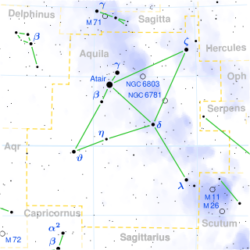
Aquila Constellation
Discover Aquila, the eagle, in Greek mythology. Explore its notable stars like Altair and Alshain, as well as intriguing deep-sky objects.
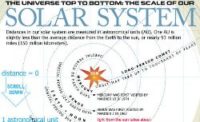
The Solar System To Scale [Infographic]
The following is a huge infographic showing the true scale of the solar system with all its planets, minor bodies and the most famous probes we have sent out into deep space. Scientists measure distances in our solar system in astronomical units (AU).
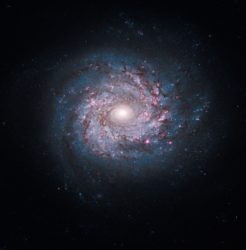
Astronomy Picture of the Week – Spiral Galaxy NGC 3982
This spiral galaxy, called NGC 3982, looks similar to our own galaxy but it is much smaller. NGC 3982 spans about 30,000 light-years which makes it roughly one-third of the size of the Milky Way galaxy. It is located about 68 million light-years away in the constellation Ursa Major. This image is composed of pictures taken by the Hubble Space Telescope’s Wide Field Planetary Camera 2 (WFPC2), the Advanced Camera for Surveys (ACS), and the Wide Field Camera 3 (WFC3) between March 2000 and August 2009. Image Credit: NASA, ESA, and the Hubble Heritage Team (STScI/AURA)